The Asymmetric Advantage: Why Missing Out on "Big Tech" Partnerships Is a Win for Emerging Biotechs
Uplizd Powers Your Stack

Every week, a familiar headline flashes across the biotech and pharmaceutical industry: another legacy pharma giant has signed a multi-million-dollar, exclusive partnership with a closed-source AI titan or a massive hardware provider.
If you are leading engineering, data science, or visionary operations at a younger, leaner biotech startup, it is easy to look at those press releases and feel a spike of anxiety. It feels like the sandbox has been locked, the keys have been handed over to the incumbents, and the ship has sailed.
But if you look under the hood of how these massive partnerships are actually structured, a very different reality emerges. You didn't miss the game. In fact, by staying out of the early hype cycle, you might have just avoided a massive technical trap.
The Hidden Architecture of Dependency
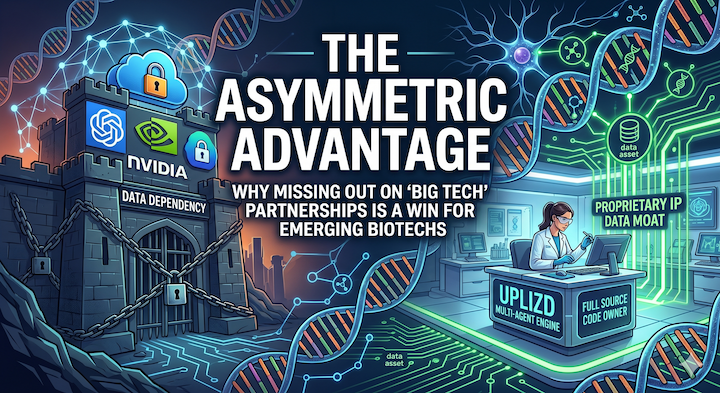
Many of the blockbuster AI alliances dominating the news are built on a fragile foundation: structural dependency. When an organization builds its core drug discovery pipelines on top of third-party, closed-source APIs or external enterprise "wrappers," they aren't building a truly proprietary asset. They are building a house on rented land.
From an engineering and infrastructure perspective, this introduces three critical vulnerabilities:
1. The Data Sovereignty Paradox
Your data—your novel target insights, molecular structures, and clinical data—is your company's greatest asset. The moment you push that highly sensitive data through an external, third-party ecosystem, you dilute your competitive data moat. Even with enterprise data privacy agreements, you are relying on a black-box system where you cannot audit how your data interacts with the underlying weights of the model.
2. Upstream Product Risk
When you rely on a third-party vendor's API, your core pipeline is tied to their product roadmap. If they deprecate a feature, shift their pricing model, or modify their underlying orchestration framework, your pipeline can break overnight. For a startup, that means burned runway and unplanned engineering cycles spent fixing someone else’s code.
3. The Valuation Bottleneck
If your entire AI capability disappears the moment you stop paying a monthly SaaS subscription or API fee, you haven't built a technology asset. You’ve built an operational expense. When savvy venture capitalists or M&A teams look at your technical stack during a funding round, they can tell the difference between a company that owns its intelligence and one that merely rents it.
For an agile biotech, your greatest weapons are speed, flexibility, and absolute control over your intellectual property. You don't need a giant tech logo on your pitch deck to validate your science. You need infrastructure ownership.
Flipping the Script: The Power of Owning Your Stack
By bypassing the legacy complexities that Big Pharma is currently wrestling with, smaller, nimble teams can achieve a massive, asymmetric advantage. Building on a self-owned AI infrastructure from day one allows you to leapfrog the tech debt of the past decade.
This exact philosophy is why we architected Uplizd the way we did. We don't believe in restrictive SaaS subscriptions or locking you into a proprietary cloud environment. Instead, we deliver a full source code transfer of an enterprise-grade, multi-agent AI framework directly to your team.
Here is how transitioning from a software buyer to a technology owner completely flips the competitive landscape for an emerging biotech:
- Absolute Architectural Freedom: Because you own the code, you can deploy it exactly where it makes sense—whether that is on-premises, within your own secure Virtual Private Cloud (VPC), or a hybrid environment. You can modify, optimize, and rewire the underlying multi-agent logic the exact second your biological research pivots.
- Zero Vendor Lock-In: You are completely insulated from third-party price hikes, service outages, or strategic shifts. The code is yours to run, scale, and maintain forever.
- Exponential Asset Valuation: Instead of burning precious seed or Series A capital on recurring API calls that leave you with nothing but a receipt at the end of the month, your engineering spend is converted into a tangible, balance-sheet-worthy asset. You are actively building enterprise value that scales alongside your biological discoveries.
The Paradigm Shift
The next generation of breakthrough therapies won't belong to the companies with the largest, most bloated tech partnerships. They will belong to the lean, focused teams that protected their data moats, retained absolute sovereignty over their logic, and controlled their own digital destiny from day one.
If you thought you missed the AI wave in life sciences, look closer. You just avoided getting trapped in it—and now, you're in the perfect position to build it right.